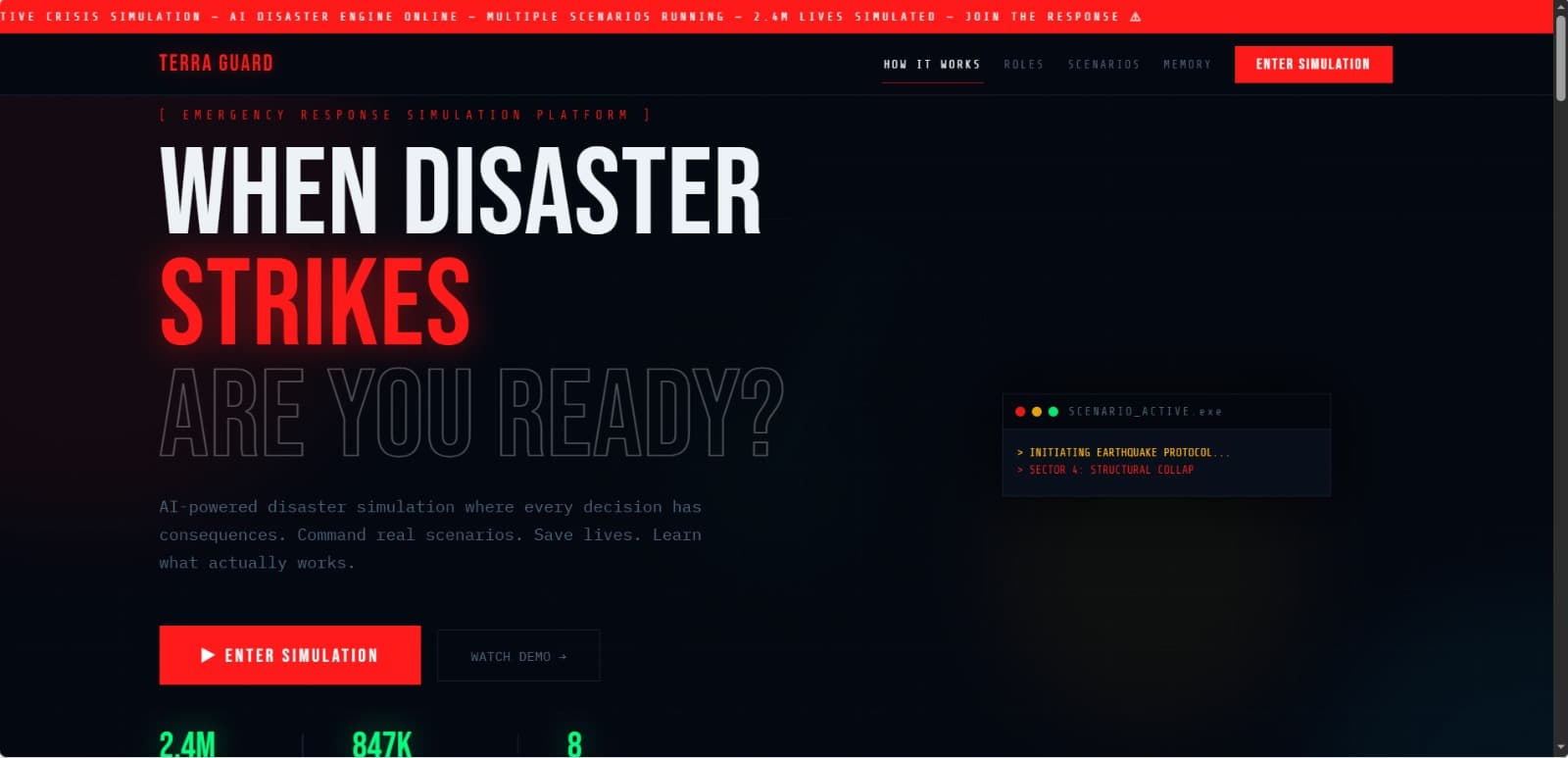
TerraGuard: Building a Real-Time AI Disaster Simulation That Learns From You
🚨 TerraGuard — Building an AI-Powered Disaster Simulation System That Learns From You
Most AI projects today stop at one thing: generate a response → show it → done.
But real-world decision-making doesn’t work like that.
In disasters, decisions:
evolve cascade have consequences and most importantly… repeat patterns
So we asked a simple question:
What if AI didn’t just respond… but simulated reality and learned from you over time?
That’s how TerraGuard was built.
🧠 The Idea
TerraGuard is an AI-powered disaster simulation system where users make decisions under pressure and the environment reacts in real time.
But unlike typical simulations:
it’s not scripted it doesn’t reset every session and it doesn’t forget your mistakes
It evolves with you.
⚙️ How TerraGuard Works
At its core, TerraGuard is a state-driven simulation engine powered by AI.
The loop is simple:
AI generates a disaster scenario User makes a decision System evaluates impact Scenario evolves Repeat for multiple rounds
But the execution is where things get interesting.
🔄 Real-Time AI Simulation (Not Just Chat)
Instead of waiting for full responses, we implemented streaming AI responses.
AI sends output incrementally Frontend renders it using a typewriter effect Users experience a live unfolding situation
This creates:
lower perceived latency higher immersion real-time urgency 🎮 Multiple Modes = Different Realities
We didn’t want a one-dimensional experience.
So TerraGuard introduces three distinct modes:
👤 Citizen Mode Personal survival decisions Small-scale impact Emotion-driven scenarios 🚑 Coordinator Mode Resource management (ambulances, rescue teams) Multiple simultaneous emergencies Trade-offs and prioritization 🏛 Official Mode Large-scale decision making Public communication Budget and inter-agency coordination
Each mode changes:
scale complexity consequences 🧱 System Architecture Frontend React (Vite + TypeScript) Tailwind CSS Context + useReducer (state management)
The frontend acts as:
a real-time simulation controller, not just UI
Backend Node.js + Express
Used as:
secure API proxy streaming handler (SSE) memory integration layer AI Layer Google Gemini (primary) Groq (fallback)
Key decision:
enforce structured JSON output maintain consistency across rounds ⚡ Streaming with SSE (Server-Sent Events)
One of the hardest parts was implementing streaming correctly.
Instead of:
request → wait → response
We built:
request → stream → render progressively
Challenges:
handling partial data reconstructing valid JSON syncing UI updates
Result:
A real-time, responsive simulation experience
🧠 The Biggest Upgrade: Memory with Hindsight
Most AI apps are stateless.
You close the tab → everything is gone.
That’s where TerraGuard becomes different.
We integrated a memory layer using Hindsight.
🔁 What Memory Enables
- Retain (During Simulation)
Stores:
decisions outcomes context 2. Recall (Before Simulation)
Fetches:
past behavior repeated mistakes
Then injects into AI prompt.
- Reflect (After Simulation)
Generates:
behavioral insights improvement suggestions 💥 Result
The system can now:
detect patterns adapt scenarios personalize feedback
Example:
“You tend to delay evacuation decisions — this has cost lives in previous sessions.”
That’s not a feature. That’s learning behavior modeling.
📊 Final Output: After-Action Report
At the end of each simulation, TerraGuard generates a detailed report:
Lives saved vs lost Performance score and grade Round-by-round analysis Critical mistakes Best decisions Real-world insights
And with memory:
behavioral profile pattern detection improvement recommendations ⚠️ Challenges We Faced
- JSON Reliability
AI doesn’t always behave.
Solution:
enforce structured output add parsing fallback 2. Streaming Complexity
Handling partial responses without breaking UI.
- State Synchronization
Keeping frontend state aligned with AI output across rounds.
- Memory Integration
Making it meaningful — not just storing logs.
🧠 What We Actually Built
Not:
a chatbot a game a demo project
But:
a real-time AI simulation engine with memory-driven behavior adaptation
🚀 What’s Next
If taken further, TerraGuard can evolve into:
disaster training tools emergency response simulations decision-making training platforms 💡 Final Thought
AI shouldn’t just answer questions.
It should:
simulate environments challenge decisions and help you improve over time
TerraGuard is a step in that direction.
🔗 Tech Stack Frontend: React (Vite + TypeScript), Tailwind Backend: Node.js + Express AI: Gemini + Groq fallback Memory: Hindsight
🙌 Closing
This project started as a hackathon idea. But it turned into something deeper:
a system that doesn’t just respond — it reacts, evolves, and remembers.